When we were young we were fearless. You talk to children and ask what they want to be when they grow up and the answers will widely vary. Some may want to be President, some a garbage person, some an astronaut, some a doctor, but rarely will they say they want to do anything average or mundane with their life.
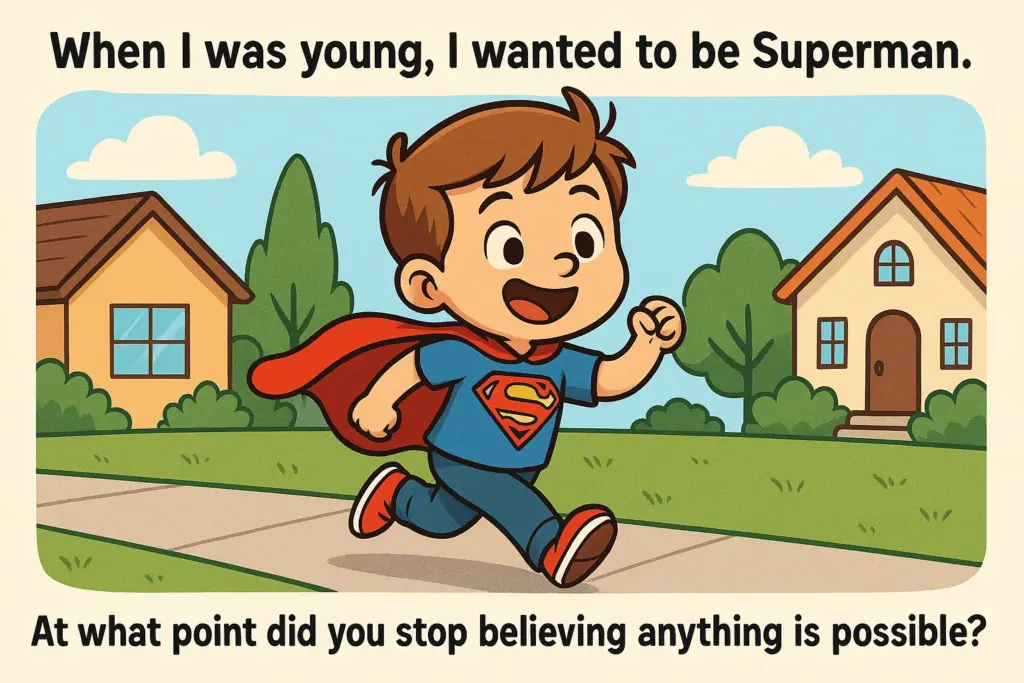
When I was really young and obviously had no clue about reality I wanted to be Superman. I had my trusty pillow case my mom would pin to the back of my shirt and I’m sure I really believed I was Superman running down the street (faster than a speeding bullet I might add). Everything is possible through the eyes of a child. At what point did you stop believing anything is possible?
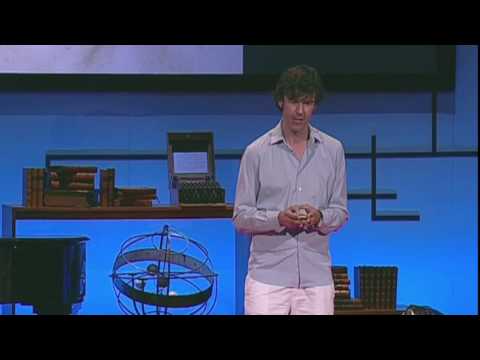
“Every seven years, designer Stefan Sagmeister closes his New York studio for a yearlong sabbatical to rejuvenate and refresh their creative outlook. He explains the often overlooked value of time off and shows the innovative projects inspired by his time in Bali. (Recorded at TEDGlobal, July 2009, Oxford, UK.Duration: 017:40)”
My Notes:
Sagmeister decided to disperse retirement throughout his life. He has a design studio which has done work for the Rolling Stones, Adobe, Lou Reed, and more. His TED talk above is pretty boring, I won’t lie, and I actually didn’t listen to the whole thing. What I like about what he does is take time to rejuvenate himself throughout his life (very Tim Ferriss like). Most people retire to enjoy themselves, and live out their calling toward the end of their life as opposed to doing so throughout it when we are more physically, intellectually, and emotionally able to benefit.
He found most people in general spend:
25 years learning
40 years working
15 years in retirement
After the 25 years of learning people tend to find a job and maybe a career but few find their calling. He defines the three areas as:
Job: Done for money, 9-5
Career: Advancement and promotion
Calling: Intrinsically fulfilling
Sagmeister is obviously brililant at design as demonstrated in the video below. Look at what he was able to do with his book titled “Things I have Learned In My Life“. Simply amazing…
3 years ago she became a working homeless because she quit her job as a newspaper editor after her father died.
Lived in her van with her cat and rottweiler for a year
Failed to realize three critical things:
Society equates living in a permanent structure (even a shack) as having a value as a person
Failed to realize how quickly the negative perceptions of other people can impact our reality if we let it
Failed to realize that homelessness is an attitude, not a lifestyle
Tim Russert included an essay she had written about her father in his book. She went into a bookstore and reread her essay and realized she needed to get back to her passion and fight her depression
The human spirit can overcome anything if it has hope
Hope always finds a way
Becky continues to write on her blog and has written a free eBook called Homeless for the Holidays about how to truly help the Homeless.
My favorite video hosting site Vimeo has launched a new desktop uploader which allows you to upload and configure your favorite videos you want to share without having to launch a browser. The open source community needs to come up with a standard to compete but for now Adobe Air is king which Vimeo has chosen to use as its platform.
If you haven’t heard about our Bay Area traffic nightmare, the Bay Bridge has been closed since Tuesday when a 5,000 pound steel beam decided to crash onto the upper deck. They are building a new bridge but it isn’t expected to be completed until 2013. People are having to use BART (love BART) now and according to sfgate.com, records were broken on Thursday with 442,000 passengers, using the trains.
I don’t know what correlation you want to draw from this but I found the above chart interesting. Although there appears to be some obvious correlations. the higher income due to higher SAT scores could be for numerous reasons other than “I scored better on the SAT so I I got a better job and make more”. One correlation is they are measuring family income and I would imagine people who scored higher on their SATs met other people who scored higher on their SATs in college and social gatherings. I’m also not sure the SAT is a good measurement for what makes a person successful in the world but maybe it is? Then again maybe I’m just jealous of all those smart rich folk! I’m still waiting for the money vs. perceived happiness chart to come out.